










The Coerver Youth Diploma 1 is for coaches who want more than a list of soccer drills.
It is designed to explain how a coach can organize technical development, progress skills into competitive pressure and build practices around a consistent player-development philosophy.
That distinction is important.
A drill tells you what the players will do for ten minutes. A coaching method helps you decide why they are doing it, what should come next and how the activity connects to the game.
This Coerver Youth Diploma 1 review examines the published course curriculum, its practical value and the type of coach most likely to benefit.
Editor’s note: This review evaluates the published course content and its application to youth coaching. Confirm current pricing, access and completion requirements on the official product page.
View the current Youth Diploma 1 course details
Youth Diploma 1 at a Glance
| Feature | Details |
|---|---|
| Best for | Parent, grassroots, youth, club and technical-development coaches |
| Main focus | Coerver methodology and effective session planning |
| Delivery | Online course |
| Core concepts | Player Development Pyramid, Pyramid of Moves, Skills Bridge, Coerver Code and Session Planner |
| Practical content | Skills, drills, small-sided games and planning ideas |
| Completion | Coerver Youth Diploma 1 certificate of completion |
| Presenters | Coerver co-founders Alfred Galustian and Charlie Cooke |
| Current price | See the live course page |
The official course page states that participants learn the Coerver planning approach, receive a Session Planner template and earn a Youth Diploma 1 certificate of completion. The published curriculum also includes the Pyramid of Moves, Pyramid of Player Development, Skills Bridge and Coerver Code.
What Does Youth Diploma 1 Teach?
The Pyramid of Player Development
The Pyramid of Player Development organizes the Coerver curriculum into six interconnected areas:
- Ball Mastery
- Receiving and passing
- One-versus-one moves
- Speed
- Finishing
- Group play
The order is significant.
Ball Mastery gives the player the control and confidence needed to perform the other actions. Receiving and passing connect the individual to teammates. One-versus-one ability helps players keep possession and create space. Speed, finishing and group play then place those qualities into increasingly game-related situations.
The pyramid helps coaches avoid a common problem: working on whichever topic appears interesting that week without considering how the skills connect.
The Pyramid of Moves
The Pyramid of Moves breaks one-versus-one actions into teachable families.
The current course page describes 43 moves divided into changes of direction, stops and starts, and feints. Rather than treating each move as an isolated trick, the course helps coaches understand the purpose of the movement and the steps required to teach it.
This makes one-versus-one coaching easier to organize.
A player may use:
- A change of direction when the direct route is blocked.
- A stop-and-start when the defender is running alongside.
- A feint when confronting the defender from the front.
The coach is not simply teaching foot movement. The coach is teaching the player to recognize a problem and select an appropriate solution.
The Coerver Skills Bridge
Many players can perform a skill during an unopposed exercise but cannot reproduce it in a match.
The Skills Bridge addresses that gap through graduated pressure.
A practical progression is:
- Learn the technique.
- Repeat the movement.
- Add direction and speed.
- Introduce passive pressure.
- Add active pressure.
- Apply the skill in a small-sided game.
- Recognize the moment in normal play.
This progression is one of the most valuable concepts for youth coaches.
When pressure is introduced too quickly, players may abandon the new skill. When pressure is never introduced, the skill remains disconnected from the game.
The Coerver Code
The course presents five qualities:
- Skill
- Speed
- Strength
- Spirit
- Smarts
These qualities remind coaches that player development is not purely technical.
A player needs skill to manipulate the ball, speed to act effectively, strength to compete, spirit to respond positively and smarts to make decisions.
The objective is not to teach each quality as a separate lecture. It is to create practices in which the five qualities can develop together.
The Session Planner
The Session Planner provides the organizational component.
It helps coaches build practices that challenge players, reduce planning time and connect activities across weekly, monthly and season-long plans.
The course also includes a Session Planner template that coaches can use when preparing for the field.
How Youth Diploma 1 Can Change Your Practice Planning
Before using a structured method, a coach may plan like this:
- Find a warm-up.
- Find a passing drill.
- Find a shooting drill.
- Finish with a game.
The activities may all be useful, but they may have no common purpose.
After learning a connected planning approach, the coach begins differently:
Identify the game problem
Example:
Players lose possession because their first touch remains under the body.
Define the learning outcome
Players will receive with an open body position and move the ball away from pressure.
Introduce the technique
Use an unopposed receiving activity.
Add a decision
The player chooses the direction of the first touch.
Add pressure
Introduce a defender.
Create game application
Use a small-sided game that rewards receiving forward or escaping pressure.
Review the result
Observe whether the behavior appears during the match.
This is a more purposeful way to coach.
A Four-Week Youth Diploma 1 Application Plan
Completing an online course is only the beginning. The real value appears when the coach applies one concept at a time.
Week 1: Audit Your Practices
Review your last three sessions.
Ask:
- Did each practice have one clear objective?
- Did the activities connect?
- Were the players active?
- Did pressure increase gradually?
- Did the final game reinforce the theme?
- Did every player receive enough repetitions?
Choose one planning habit to improve.
Week 2: Make Ball Mastery the Foundation
Add a short Ball Mastery period to each practice.
Select two movements connected to the main theme. Do not introduce a long list of new actions.
For example, use sole rolls and pull-push movements before a practice focused on turning away from pressure.
Week 3: Teach One 1v1 Move
Choose one move and teach it through graduated pressure.
Allow players to understand the movement, perform it while dribbling, use it against passive pressure and then apply it in a one-versus-one game.
Look for a change of speed after the move.
Week 4: Connect the Skill to Group Play
Create a small-sided game in which the skill can appear naturally.
Avoid forcing the move every time a player receives the ball. Give bonus points or recognition when a successful action creates an advantage.
At the end of four weeks, repeat the audit.
Who Should Take Youth Diploma 1?
Parent and volunteer coaches
The course can provide a clearer framework for people who have been asked to coach but have limited formal education.
Grassroots coaches
Grassroots coaches can use the course to improve session organization, technical instruction and player engagement.
Competitive youth coaches
Coaches working with more experienced players can use the graduated-pressure method to make technical practice more game effective.
Club coaches
Clubs can use the curriculum to create a shared language across several teams and age groups.
Individual trainers
Private trainers can use the methodology to connect isolated skill work to realistic decisions.
Experienced coaches
Experienced coaches may already understand many of the activities but can still benefit from reviewing the progression, structure and teaching language.
Who May Not Need the Full Course?
Youth Diploma 1 may not be the first purchase for a coach who:
- Only wants a small library of Ball Mastery exercises.
- Only wants new one-versus-one moves.
- Needs a quick practice-planning tool rather than a broader course.
- Is seeking a national federation coaching license.
- Has no intention of applying the material consistently.
A coach seeking only practice content may prefer the Coerver Session Planner.
A coach seeking one technical area may prefer Ball Mastery or Moves.
A coach seeking an official federation license should follow the licensing pathway offered by the relevant national governing body. The Youth Diploma is a Coerver certificate of completion and should be presented accurately as such.
Youth Diploma 1 Compared With Other Coerver Resources
| Resource | Primary purpose |
|---|---|
| Session Planner | Organizing practices and finding adaptable activities |
| First Skills | Coaching beginner players |
| Ball Mastery | Improving touch and control |
| Moves | Teaching individual soccer moves |
| Youth Diploma 1 | Learning the Coerver method and planning philosophy |
| Youth Diploma 2 | Connecting individual development with more advanced team play |
| Ultimate Bundle | Accessing several core training products |
| Platinum Package | Accessing the broadest published online product collection |
Youth Diploma 1 vs. Session Planner
Choose Session Planner when you primarily need practical planning content.
Choose Youth Diploma 1 when you want to understand the coaching method that guides the planning.
Youth Diploma 1 vs. Youth Diploma 2
Youth Diploma 1 establishes the methodology, individual development principles and session-planning approach.
Youth Diploma 2 builds on Youth Diploma 1 and focuses on Coerver’s approach to team play. It covers the BOX/TRAP team system, the individual and small-group skills a BOX/TRAP team needs, the Coerver Code of the 5 S’s (Skills, Smarts, Speed, Strength and Spirit), and the growth mindset. Learn more on the Youth Diploma 2 course page.
Youth Diploma 1 vs. Ultimate Bundle
Choose Youth Diploma 1 when coach education is the priority.
Choose the Ultimate Bundle when you want a broader collection of practical resources covering planning, beginner coaching, one-versus-one development, individual training and other topics.
Compare the complete Coerver product pathway
Strengths of Youth Diploma 1
It provides a method rather than isolated activities
The course helps coaches understand how development topics relate to one another.
It emphasizes session planning
Coaches learn to build practices with a clearer objective and progression.
It explains graduated pressure
The Skills Bridge helps connect technical repetition to game performance.
It covers individual and group development
Ball Mastery and one-versus-one ability are connected to passing, finishing and group play.
It can improve coaching language
A consistent framework makes demonstrations and coaching points easier to organize.
It includes a certificate of completion
Coaches can document their continued education accurately in a coaching résumé or biography.
Points to Consider Before Enrolling
Course completion is not the same as mastery
The coach must deliver, observe, reflect and adapt.
The volume of content requires focus
Do not attempt to introduce every concept during the first week.
The method should be adapted
A U7 recreational team and a U15 competitive team should not receive the same pressure, complexity or coaching language.
It does not replace federation licensing
Use it as specialist coach education that complements other learning pathways.
The value depends on implementation
The strongest course will have limited impact if the coach continues using disconnected practices.
Who Youth Diploma 1 Is Designed For
According to Coerver Coaching, Youth Diploma 1 is designed for coaches who work with young players aged 8 to 16, at every level from beginner to advanced, including teachers and parents. It was developed by Coerver co-founders Charlie Cooke and Alfred Galustian, with a specific focus on session planning. The course covers four modules: the Coerver approach to coaching, the Coerver curriculum, the Coerver Session Planner, and Coerver tips to be a better coach.
If there is a Coerver program near you, the shorter, in-person Coerver Intro Course gives coaches a practical overview of Coerver Ball Mastery and 1v1 Mirror Moves. Want a coach’s perspective? Read journalist and youth coach Gary Parkinson’s Youth Diploma 1 review.
Frequently Asked Questions
Is Youth Diploma 1 suitable for a beginner coach?
Yes. It is presented for coaches of different experience levels. A beginner should apply the content gradually rather than attempting to use everything immediately.
Is the course completed online?
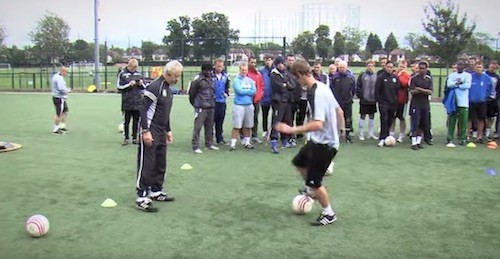
Yes. Youth Diploma 1 is available as an online course you can complete at your own pace. Coerver also delivers it as a live two-day course, in four 3-hour modules of classroom and on-field sessions, through local Coerver programs.
Do I receive a certificate?
The published course page states that participants receive an official Coerver Coaching Youth Diploma 1 Online certificate of completion.
Is the Youth Diploma a national coaching license?
No. It is specialist Coerver coach education and a certificate of completion. It should not be represented as a national federation license or permission to operate commercial Coerver programs.
Does the course include practice-planning material?
Yes. Session planning is a central component, and the published course includes a Session Planner template.
Can experienced coaches benefit?
Yes. Experienced coaches can compare their current methods with the Coerver development framework and use the course to refresh technical teaching and practice progression.
Coerver Youth Diploma 1 Review: Final Verdict
Youth Diploma 1 is best suited to coaches who are ready to become more deliberate about player development.
It is not simply a database of activities. Its value comes from helping the coach understand:
- What to teach
- Why the topic matters
- How to break down the skill
- When to add pressure
- How to connect the skill to the game
- How to organize the work across a season
The course will not remove the need for coaching judgment. It should improve that judgment by giving the coach a clearer structure.
For a coach who wants only a few new drills, a smaller product may be sufficient.
For a coach who wants a repeatable technical-development method, Youth Diploma 1 is the more complete educational choice.
Explore Coerver Youth Diploma 1
Become a Coerver-trained coach.
Coerver Coaching’s online Youth Diploma courses give you a proven method for teaching skills. Youth Diploma 1 covers session planning for players aged 8 to 16. Youth Diploma 2 covers team play.