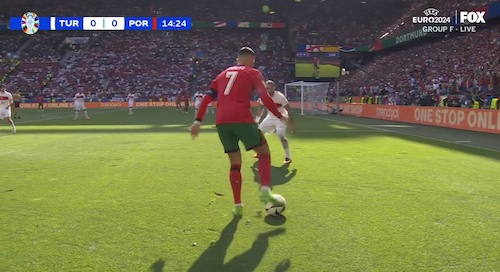








The half turn in soccer means receiving the ball with your body open, at an angle of roughly 45 degrees, instead of with your back to the field. When you are half-turned, you can see where the ball is coming from and where you want to play it next. That lets you take your first touch forward and play faster.
So what does “half turn” mean in football? It is a body position and a way of receiving. Midfielders use it most, but wingers, fullbacks and forwards all need it. The goal is simple: be ready to turn before the ball arrives, so you save valuable seconds and do not get trapped facing your own goal.
What Is the Half Turn in Soccer?
When a midfielder checks back toward the ball with their back fully turned to the opponent’s goal, they can only see one direction. They usually have to play the ball back where it came from. A midfielder who is half-turned, facing toward one of the sidelines, can see the defenders behind the ball and the forwards and midfielders ahead of it at the same time.
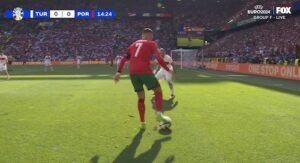
Wide players use the same idea. If you are on the wing near the touchline, turn your shoulder toward the outside line so you are open to the whole field. Instead of having your back to the forwards, you can see the play and receive the ball moving forward.
Learn from the best midfielders
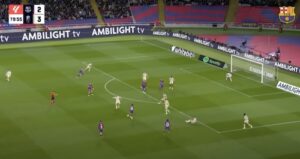
Watch Sergio Busquets or Xavi from their years at Barcelona. They constantly looked over their shoulders before receiving the ball, so they knew whether a defender was coming or whether they had space to turn. They rarely checked back with their back to the rest of the field. Luka Modric and N’Golo Kante, shown in the video above, are other great examples of players who receive on the half turn and play forward quickly.
The half turn is one of the most essential skills for a midfielder. To pull it off, you must be aware of the space behind you so you do not turn into a defender. That is why checking your shoulder matters so much. You do not need a ton of space. You need to know where you are, where the defender is, and which way is open.
How to Receive on the Half Turn: Step by Step
- Scan before the ball is played. Look over both shoulders while the ball is on its way to the passer. Note where the nearest defender is and where the space is.
- Open your body. Stand side-on, with your hips and chest facing toward a sideline at roughly a 45-degree angle, so you can see the ball and the field ahead.
- Check away, then check to the ball. Create space by moving away from your marker, then come toward the ball at an angle, not in a straight line.
- Scan one more time. Take a final quick look just before the ball arrives. The picture may have changed.
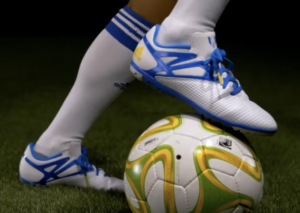
- Receive across your body with the back foot. Let the ball run across you and take it with the foot farthest from the passer. This turns you toward the field naturally.
- Make your first touch go forward. Push the ball into the space you saw, not under your feet. A good half-turn touch sets up your next pass or dribble.
- Play quickly. Pass, dribble or switch the play while the defense is still adjusting.
Back foot vs. receiving on the turn
Receiving on the back foot means letting the ball travel across your body and controlling it with the foot farther from the passer. Receiving on the turn means using that touch to rotate and face forward in one motion. They work together. If a defender is tight, you may need to protect the ball first. If there is space, take it forward right away.
Common Mistakes
- Not scanning. Turning without looking is how players turn straight into a defender.
- Square body position. Standing flat with your back to goal limits you to playing backward.
- Receiving with the front foot. Using the foot closest to the passer stops the ball in front of you and closes your body off.
- A heavy or flat first touch. Stopping the ball dead under your feet wastes the advantage you created.
- Checking in a straight line. Coming straight at the passer makes it easy for your marker to follow and press.
- Forcing the turn. If a defender is right behind you, the smart choice may be to play it back and move again.
Practice Session: Half Turn Drill
This 30-minute session works for small groups of three to six players.
- Passing triangles (6 minutes): Three players in a triangle with sides of about 10 yards. Each player receives on the back foot and passes to the next player. Switch direction every 2 minutes.
- Middle player turns (8 minutes): Two servers stand 20 yards apart with a receiver in the middle. The receiver checks to one server, scans, receives on the half turn and passes to the other server. Do 10 reps, then rotate.
- Coach’s call (6 minutes): Same setup, but a coach behind the receiver holds up a hand or calls “turn” or “man on” as the pass is played. The receiver must scan to see the signal and choose to turn or play it back.
- Passive defender (6 minutes): Add a defender behind the middle player who can shadow but not tackle. The receiver must use scanning and body shape to find the open side.
- Small-sided game (4 minutes or more): Play 3v3 or 4v4 with a target player at each end. Award a bonus point when a midfielder receives on the half turn and plays forward.
The Coerver Angle
Coerver Coaching builds every player’s game on ball mastery and first touch, and the half turn is where those skills meet game intelligence. Players who have done thousands of touches on the ball can receive without staring at it, which frees their eyes to scan the field. We teach receiving and turning as core skills, then put them under pressure in small-sided games so players learn to make the right decision, not just the right touch.
To go deeper, read about the art of Sergio Busquets, learn how to play like Xavi, and review the attributes of quality midfielders.
Frequently Asked Questions
What does half turn mean in football?
It means receiving the ball with your body open at an angle, usually facing a sideline, so you can see both behind and ahead of you and turn forward with your first touch.
Which foot should I receive with on the half turn?
Usually your back foot, the one farther from the passer. It lets the ball travel across your body and opens you up to the field.
Is the half turn the same as the half-space?
No. The half turn is a body position for receiving. The half-spaces are the vertical channels between the middle of the field and the wings. Players often receive on the half turn in the half-spaces, but they are different ideas.
How do I know if I have space to turn?
Scan over your shoulder before the ball arrives. If the nearest defender is a few yards away or off to one side, you can usually turn. If they are tight behind you, protect the ball or play it back.