







Want to learn how to play like Pirlo? Start with your eyes, not your feet. Andrea Pirlo was never the fastest or strongest player on the field, yet he controlled games for AC Milan, Juventus and Italy because he saw the picture before the ball arrived, kept it under pressure and then hit passes that split whole defenses.
Andrea Pirlo’s skills come down to four things young players can copy: scanning, a calm first touch, a huge range of passing (short, long and disguised) and clever body positioning to shield the ball. This page breaks down his playing style, shows you the famous blind pass in the video below and gives you a training session to build Pirlo’s habits.
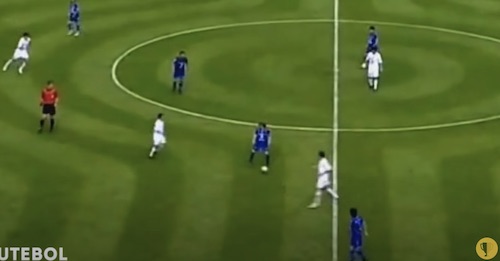
In the clip, Pirlo demonstrates the blind pass: he looks one way and passes the other. It works because defenders read a passer’s eyes and hips. When those point in one direction, the defense shifts that way, and the real pass goes into the space they just left.
Andrea Pirlo’s Playing Style: Who He Was and Why It Matters
Pirlo came through at Brescia in Italy and later moved to Inter Milan before making his name at AC Milan, where he won the Champions League in 2003 and 2007. He then joined Juventus in 2011 and won several Serie A titles there before finishing his career with New York City FC in MLS. He retired in 2017. With Italy, he won the 2006 World Cup.
He started out as an attacking midfielder, but coaches moved him deeper, in front of the back line. In Italy that role is called the regista, or deep-lying playmaker. From there, Pirlo had time to look up and play every pass on the field. Instead of trying to dribble past people, he moved the ball so quickly and accurately that pressure rarely reached him.
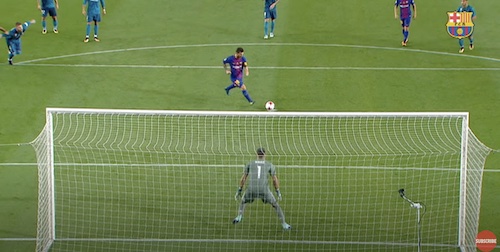
That is the big lesson for youth players. You do not need elite speed or a big physique to influence a game. Pirlo’s physique was ordinary for a pro. What made him special was decision-making, technique on both short and long passes and composure. He was also a famous dead-ball specialist, and his calm chipped penalty against England in the Euro 2012 quarterfinal shootout is still one of the coolest moments in Italian soccer.
Pirlo Skills: How to Practice His Signature Moves
Here are the Andrea Pirlo skills worth copying, and exactly how to practice each one.
- Scanning before the ball arrives. Pirlo checked his shoulders constantly so he already knew his next pass. Practice: in any passing drill, have a partner hold up a number of fingers behind you just before passing. Call out the number before you receive. Aim to look over both shoulders before every touch.
- The open-body first touch. Pirlo received the ball on his back foot (the foot farther from the passer) with his body half-turned, so he could see the whole field. Practice: set up two cones as a gate on your side. Receive across your body and push the ball through the gate with one touch, then pass. Do 20 on each side.
- The long diagonal pass. His trademark was the 40-yard switch of play landing at a teammate’s feet. Approach the ball at a slight angle, plant your standing foot beside it, strike through the lower half with the instep and follow through toward the target. Practice: with a partner 30 to 40 yards away, aim for a 5-yard square. Count how many land in the square out of 10.
- The blind (no-look) pass. Look and open your hips toward one option, then pass to another with the inside or outside of the foot. Practice: stand between two partners and a passive defender. Fake with your eyes to one partner and pass to the other. Make the fake believable before you speed it up.
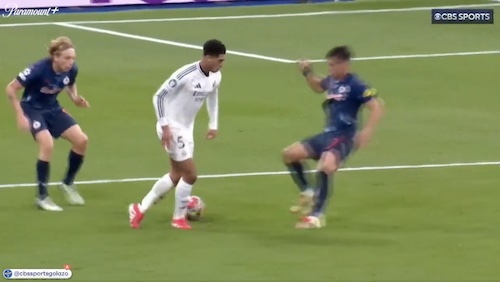
- Shielding under pressure. Pirlo kept his body between the defender and the ball, arm out for balance and knees bent, then released the ball when the pass opened. Practice: 1v1 in a 10×10 grid, shielding for 30 seconds while a partner tries to touch the ball. Rest and swap.
Common Mistakes When Trying to Play Like Pirlo
- Not scanning. Players copy the long pass but skip the shoulder checks that make it possible.
- Receiving square-on. Facing the passer with closed hips means you can only play back the way the ball came.
- Forcing the long ball. Pirlo played simple short passes far more often than long ones. The long switch works because the short game sets it up.
- Staring at the target. If your eyes and hips give away the pass, good defenders will read it every time.
- Standing still. Calm does not mean stationary. Small adjustments into open pockets keep passing lanes open.
Pirlo Training Session: 45 Minutes to Better Passing
- Warm-up: ball mastery (8 minutes). Sole rolls, inside-inside touches and pull-push moves, 30 seconds each with 15 seconds rest. Both feet.
- Scanning passes (8 minutes). Pairs 15 yards apart. Before each receive, check both shoulders and call “check.” Two-touch passing, then one-touch for the last 3 minutes.
- Open-body receiving (8 minutes). Three players in a line. The middle player receives from one end, turns with an open body and passes to the other end. Rotate every 90 seconds.
- Long-range switches (10 minutes). Partners 30 to 40 yards apart with a 5-yard target square each. 10 passes each with the right foot, then 10 with the left. Track your score.
- Rondo with a regista (11 minutes). 5v2 in a 15×15 grid with one player fixed in the middle as the “Pirlo.” The team scores a point every time the middle player receives and plays out. Change the middle player every 2 minutes.
The Coerver Angle
At Coerver Coaching we see players like Pirlo as proof that skill starts with ball mastery. Before a player can scan, receive on the half-turn and pass with disguise, the ball has to feel like part of their body with both feet. That is why our sessions build thousands of quality touches first, then add receiving and passing under pressure, and finally put those skills into game-like situations where players have to make decisions, just as Pirlo did every week.
To keep building your passing game, read our guides to soccer passing skills, the art of genius no-look passes and how to play like Xavi, another midfielder who ran games with his passing.
Frequently Asked Questions
What was Andrea Pirlo’s playing style?
Pirlo was a deep-lying playmaker, or regista. He played in front of the defense and controlled the tempo with accurate short passes, long diagonal switches and clever disguise rather than speed or dribbling.
Was Pirlo a good dribbler?
Pirlo was not a dribbler in the style of a winger. His dribbling was about protecting the ball, shifting it a yard to open a passing lane and escaping pressure with a calm touch rather than beating players one after another.
How can a youth player train like Pirlo?
Practice scanning before every touch, receiving with an open body, passing with both feet over short and long distances and shielding the ball. Rondos and long-passing target games are great for this.
Do you need to be fast or strong to play like Pirlo?
No. Pirlo showed that vision, technique and composure can outweigh pace and physique. Quick thinking lets you play the ball before pressure arrives.