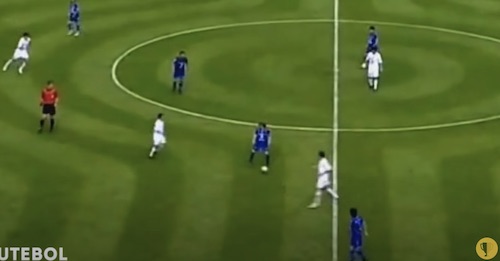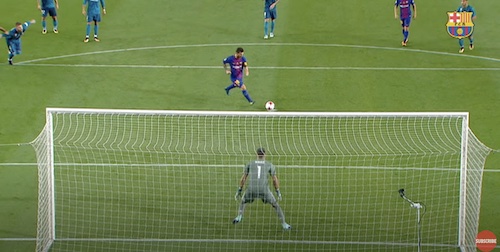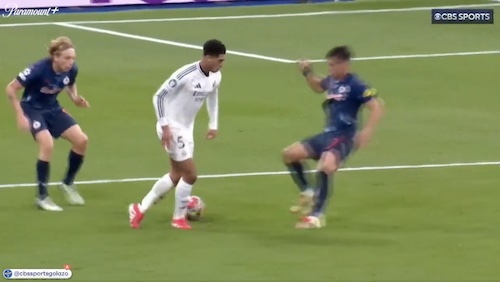










The snake soccer move is the skill most players know as the elastico or flip flap. In one quick motion you push the ball to the outside with the outside of your foot, then whip it back across your body with the inside of the same foot. To a defender, the ball seems to slither one way and then strike the other, which is why it earned the name “snake.”
Ronaldinho made the snake move famous around the world, but it is not just a highlight trick. Done at the right moment, it unbalances a defender who is set to block one direction. Below you will learn where the move came from, how to do it step by step and how to practice it until it works in games.
The video slows the elastico way down so you can see the key detail: the foot wraps around the ball, staying in contact for both touches, rather than kicking it out and then kicking it back.
Where the Snake Move Came From
The elastico is widely credited to Brazilian great Roberto Rivelino, who used it in the 1970s. Rivelino has said he picked it up from a youth teammate, Sergio Echigo. A generation later, Ronaldinho turned it into his calling card during his years at Paris Saint-Germain, Barcelona and AC Milan, often hitting it at full speed against top defenders. Ronaldinho has since retired, but clips of his elastico are still how most young players first discover the move.
Plenty of other stars have used versions of it, including both Ronaldos (the Brazilian Ronaldo and Cristiano Ronaldo). You will also see people search for a “Ronaldo snake move” or “Zlatan snake move.” Those names get used loosely for different players’ clips, but the core skill is the same: an outside-to-inside wrap of the ball with one foot.
Why does it work so well? Defenders are taught to watch the ball and the attacker’s hips. The outside push and lean tell the defender you are going one way, so they shift their weight to block it. The instant they commit, the ball snaps back the other way, and their feet are stuck. Ronaldinho was so effective because he combined the move with a convincing body feint and real acceleration out of it.
How to Do the Snake Soccer Move: Step by Step
- Approach at a controlled speed. Dribble toward the defender with the ball close, about a step in front of you. Too fast and you will lose control; too slow and the defender will step in.
- Plant your standing foot. Keep your weight balanced over your standing foot, knees bent. If you are using your right foot, your left foot is the anchor.
- Push out with the outside of the foot. Touch the ball a few inches to the outside with the outside of your toes. Lean your shoulders slightly the same way to sell it.
- Wrap and snap back. Without lifting your foot off the ball, rotate your ankle and drag the ball back across your body with the inside of your foot. This is the “snake strike.”
- Explode away. Push off and accelerate past the defender on the inside. The move is only as good as your burst away from it.
Common Mistakes
- Two separate touches. If the foot leaves the ball between the push and the pull, the defender has time to react. Keep it one fluid motion.
- Pushing the ball too far. The outside touch should travel only a few inches. Push it a yard and you cannot get your foot around it.
- Doing it too far away. Start the move when the defender is about one to two yards away. From farther, they simply wait for you.
- No body feint. The shoulders and hips sell the first direction. Without them, the move is just footwork.
- Forgetting to accelerate. Many players complete the elastico and then stop. Always attack the space after it.
Practice Session: Elastico in 30 Minutes
- Standing flip flaps (5 minutes). Balance on your left foot and flip flap the ball with your right, slowly, 10 reps. Switch feet. Repeat for 5 sets each side.
- Walking elastico (5 minutes). Dribble slowly along a line of cones 3 yards apart. Do an elastico at each cone. Two lengths with each foot.
- Speed build-up (5 minutes). Same cones, jogging pace, then three-quarter pace. Focus on keeping your foot on the ball.
- Passive defender (7 minutes). A partner stands still with legs shoulder-width apart. Approach, fake outside, snake back inside and explode past. 8 reps each foot, then swap roles.
- 1v1 to small goals (8 minutes). Live 1v1 in a 15×10 grid. Attackers earn 2 points for a goal scored after a successful elastico, 1 point for any other goal. 45-second rounds with rest.
The Coerver Angle
Coerver Coaching teaches moves like the elastico in the order that makes them work: ball mastery first, then the move in isolation, then the move against pressure, then the move in game situations. Thousands of repetitions with both feet build the soft touch the snake move needs. And just as important, we teach players when to use a move, so it beats defenders rather than becoming a party trick.
For more on this family of skills, read how to do Ronaldinho’s air elastico, revisit the three Rs: Ronaldinho, Rivaldo and Ronaldo and add more tools from our list of Coerver moves to beat any opponent.
Frequently Asked Questions
Is the snake move the same as the elastico?
Yes. The snake move, the elastico (sometimes misspelled “elatico”) and the flip flap are names for the same skill: an outside push followed by an inside pull with the same foot in one motion.
Who invented the elastico?
Roberto Rivelino is widely credited with bringing it to the world stage in the 1970s, and he has credited a youth teammate, Sergio Echigo. Ronaldinho made it famous for a new generation.
How long does it take to learn the snake move?
It varies by player, but most young players can do a slow version within a few practices. Doing it at speed against a real defender takes regular practice over several weeks.
What age can kids start learning the flip flap?
Players can start with slow, standing flip flaps as soon as they are comfortable with basic ball mastery. Keep it fun and focus on soft touches before speed.