








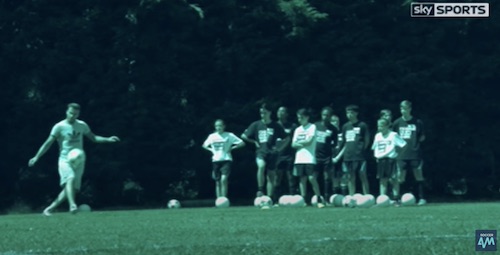
David Beckham’s crossing technique is one of the most studied skills in soccer, and in this masterclass for Sky Sports’ Game Changers, Beckham shows exactly how he did it. His crosses were whipped in at pace with a curve that bent away from the goalkeeper and toward the attackers. The forward only needed to get a touch to score, and goalkeepers struggled to judge the flight of the ball.
The secret to a Beckham cross is simple to describe and hard to master: strike through the ball with the inside of the instep, wrap your foot around it to create curl, and aim for the space between the goalkeeper and the defenders. Watch the video, then use the steps and drill below to practice it yourself.
Why Beckham Is Remembered as One of the Best Crossers Ever
Beckham came through the Manchester United youth system in the early 1990s and became a key part of Sir Alex Ferguson’s team on the right side of midfield. He later played for Real Madrid, LA Galaxy, AC Milan on loan and Paris Saint-Germain before retiring in 2013. He also captained England.
His right foot produced some of the most famous moments of the era. In the 1999 Champions League final against Bayern Munich, Manchester United scored twice in stoppage time, and both goals came from Beckham corner kicks. In 2001, his late free kick against Greece sent England to the 2002 World Cup. Whether it was a corner, a free kick or a cross on the run, the ball arrived with the same pace and bend.
Ferguson has often spoken about Beckham’s work ethic, describing a young player who would stay behind after training to keep practicing. Those famous crosses were not luck. They were the result of thousands of repetitions.
David Beckham Crossing Technique: Step by Step
- Look up first. Before you cross, check where your attackers are running and where the goalkeeper is standing. Beckham always picked a target area, not just “the box.”
- Approach at an angle. Come in from slightly behind and to the side of the ball. For a right-footed cross, approach from the left of the ball.
- Plant your standing foot. Place it beside and slightly behind the ball, pointing roughly toward your target. Keep a slight bend in the knee.
- Strike with the inside of the instep. Contact the ball just below its middle and slightly off-center with the area where the inside of your foot meets the laces.
- Wrap your foot around the ball. Swing through and across the ball so your foot “wraps” around it. This creates the curl that bends the ball away from the goalkeeper.
- Lean back slightly. A small lean back helps lift the ball over the first defender. Lean too far and the ball sails over everyone.
- Follow through across your body. Let your kicking leg finish across your body toward the opposite side. A full follow-through adds pace.
- Whip it, do not float it. Aim for a driven cross into the “corridor of uncertainty” between the goalkeeper and the back line, where the keeper is unsure whether to come out.
Different Crosses for Different Situations
Beckham did not cross the same ball every time. A whipped cross to the near post or the space in front of the keeper rewards attackers who attack the ball early. A higher, deeper cross to the far post is useful when a tall teammate is arriving late. A low, driven cross along the ground is hard to defend when defenders are running back toward their own goal. Practice all three so you can choose the right one in a game.
Common Crossing Mistakes
- Crossing without looking. Hitting it “into the box” without a target lets the goalkeeper or defenders clear it easily.
- Floating the ball. Slow, high crosses give defenders time to set up. Pace makes crosses dangerous.
- Hitting the first defender. If the ball does not get up and over the nearest defender, the attack is over.
- Standing foot too far from the ball. This leads to a weak, scuffed strike. Plant close beside the ball.
- Leaning back too much. The ball flies over the box and out of play.
- Crossing too close to the goalkeeper. Bend the ball away from the keeper so they cannot claim it.
- Only using one foot. Defenders will show you onto your weaker side. Work on both feet.
Practice Drill: Beckham Crossing Session (About 45 Minutes)
- Warm-up passing (8 minutes). In pairs, pass with the inside of the foot over 10 to 15 yards, then progress to lofted passes over 25 to 30 yards with the inside of the instep.
- Stationary crossing (8 minutes). Place balls on the edge of the box near the sideline. Cross into a target area marked with cones between the six-yard box and the penalty spot. Ten crosses with each foot.
- Crossing on the run (10 minutes). Dribble down the wing for 15 to 20 yards and cross without stopping. Focus on looking up before the final touch. Eight to ten reps per player on each side.
- Crossing and finishing (12 minutes). Add two attackers who make near-post and far-post runs, and a goalkeeper. The crosser must pick the right run. Rotate positions every few reps.
- Game situation (7 minutes). Add one defender against the two attackers. Count goals scored from crosses. Rotate wide players so everyone practices crossing.
The Coerver Angle
Crossing is a striking skill, and like every striking skill it is built on a foundation of ball mastery. At Coerver Coaching we develop players who are comfortable on the ball with both feet, so they can beat a defender and still deliver a quality cross. A winger who can win a 1v1 and then whip the ball in like Beckham is a nightmare for any defense. Beckham’s story also reflects what we teach about repetition: great technique comes from consistent, focused practice, long before it shows up in big games.
For more on this skill, read our complete guide on how to cross a soccer ball, learn about the various ways to strike a soccer ball, and find out more about the David Beckham Academy.
Frequently Asked Questions
How did David Beckham cross the ball?
He struck the ball with the inside of the instep and wrapped his foot around it to create curl and pace. His crosses bent away from the goalkeeper into the space in front of the attackers.
What made Beckham’s crosses so hard to defend?
The combination of pace, bend and accuracy. The ball moved quickly and curved late, so goalkeepers struggled to come for it and defenders struggled to clear it.
Can young players learn to cross like Beckham?
Yes. Start with the basic technique from short distances, then build up range. Practice with both feet, and always cross toward a target area rather than just into the box.
Is there a David Beckham crossing video?
Yes. The video above is Beckham’s crossing masterclass for Sky Sports’ Game Changers, where he explains and demonstrates his technique.