


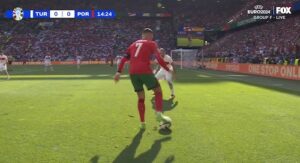






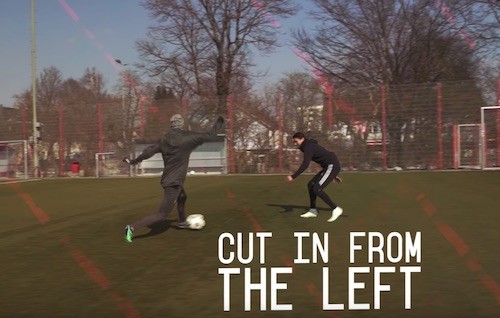
Great wingers create space in two ways: by beating defenders 1v1, and by moving at the right time so teammates can use the space they leave behind. Modern wide players combine both, switching between hugging the touchline, cutting inside and rotating with fullbacks and midfielders. Here is how winger movement works, when to dribble versus pass, and a progressive practice to teach it.
Two Types of Winger: Inverted and Touchline
The Inverted Winger
An inverted winger plays on the side opposite their strong foot, such as a left-footer on the right. Receiving wide, they can cut inside onto their stronger foot to shoot, curl a pass or combine with the center forward. Arjen Robben made the move famous (see how to play like Arjen Robben), and many of today’s best wingers use it.
Bayern Munich’s Michael Olise, a left-footer on the right, is a strong current example. Through four Bundesliga games of 2026–27, he had four goals and led the league in both shots and dribbles attempted, according to the Bundesliga’s official site, and he was then named the league’s Player of the Month for September. Barcelona’s Lamine Yamal, another left-footer, also starts from the right. Barcelona have planned to keep him on the right flank rather than move him centrally, Yahoo Sports reported in July. For more on his game, read our breakdown of Lamine Yamal’s soccer skills.
The Touchline Winger
A touchline winger plays on the side of their strong foot and aims to get to the end line and cross, or to stretch the defense by staying very wide. This keeps the field big, pulls the fullback out of the back line and opens gaps inside for midfielders and forwards. Good crossing technique is essential (see our guide to crossing technique).
The best wingers can do both. A defender who only has to stop one move is in a comfortable position. A defender who has to guess between the outside and the inside is in trouble.
Rotations: Winger, Fullback and No. 8
Rotations are pre-planned position swaps that confuse defenders about who to mark. The most common pattern on each flank involves three players: the winger, the fullback and the central midfielder on that side (the No. 8).
- Winger inside, fullback overlaps: the winger drifts into the “half-space” between the opposing fullback and center back. The fullback runs past on the outside to provide width. The defender must choose who to follow.
- Fullback inverts, winger stays wide: the fullback moves into midfield, and the winger holds the touchline. This keeps width while adding an extra midfielder to protect against counterattacks.
- No. 8 runs wide or in behind: the winger drops short toward the ball, pulling the fullback with them, and the No. 8 sprints into the space behind.
The key principle is simple: if you move, someone else fills your space. Every rotation should keep one player wide, one in the half-space and one supporting behind.
When to Dribble, When to Pass or Move
Young wingers often ask whether they should take on their defender or pass. These guidelines help:
Dribble when:
- You are isolated 1v1 in the attacking third with space to attack.
- The defender is flat-footed, square-on or still moving toward you.
- No teammate is in a better position, or beating your opponent creates a 2v1 elsewhere.
Pass or move when:
- Two defenders are closing you down.
- A teammate is making a run into space behind or inside.
- You are deep in your own half, where losing the ball is costly.
- A quick one-two will get you past the defender faster than a dribble.
Movement off the ball counts just as much. A winger who stands still makes the defender’s job easy. Checking in before spinning in behind, or drifting inside to pull a defender away, creates space even when you never touch the ball.
Skills Every Winger Needs
- A first touch that moves the ball forward, ideally while receiving on the half-turn.
- At least two moves to go each way, such as a step over to go outside and a cut to go inside. See Coerver moves to beat any opponent.
- Change of pace: slow, then explosive acceleration.
- Scanning: checking over the shoulder before receiving to see where the fullback is.
- Final product: crosses, cutbacks and shots on both feet.
From a Coerver Coaching perspective, 1v1 confidence comes first. A winger who believes they can beat their defender forces opponents to double-team, which is exactly what creates space for the rest of the team.
Progressive Practice: From 1v1 to Rotations
Step 1: Wide 1v1 Channel (10 minutes)
Mark a channel 10 yards wide and 25 yards long along the touchline, with two cone gates at the end: one on the end line (for a cross) and one cutting inside (for a shot). The attacker receives a pass from the coach and attacks the defender. Score by dribbling through either gate. Rotate roles every turn. Encourage players to use a different move each time.
Step 2: 2v1 With an Overlap (10 minutes)
Add a fullback behind the winger. The winger carries the ball inside and the fullback overlaps. The defender must choose. If the defender follows the overlap, the winger shoots or keeps dribbling; if the defender stays, the winger releases the fullback for a cross to a target.
Step 3: 3v2 Flank Rotation to Goal (15 minutes)
Use a wide zone and a goal with a goalkeeper. Winger, fullback and No. 8 play against a fullback and a midfielder. Award 2 points for a goal created by a rotation (two attackers swapping zones), 1 point for any other goal. Defenders score by winning the ball and passing to the coach.
Step 4: Game (15 minutes)
Play 6v6 or 7v7 with wide zones on each side. A goal that comes from a successful dribble or rotation in a wide zone counts double.
Frequently Asked Questions
What is the difference between an inverted winger and a traditional winger?
An inverted winger plays on the side opposite their stronger foot and likes to cut inside to shoot or pass. A traditional, or touchline, winger plays on the side of their stronger foot and looks to stay wide and cross.
What is a winger rotation in soccer?
A rotation is when the winger swaps spaces with a nearby teammate, usually the fullback or a central midfielder, to confuse defenders. The rule is that when one player leaves a space, another fills it.
How can a young player become a better winger?
Practice 1v1 moves in both directions, work on change of pace, scan before receiving, and learn when to dribble and when to pass. Small-sided games with wide zones are a great way to build these habits.
Want to pull off moves like these?
Coerver Moves breaks down the 1v1 moves the world’s best players use, step by step on video, so you can practise them at home and use them in games.