









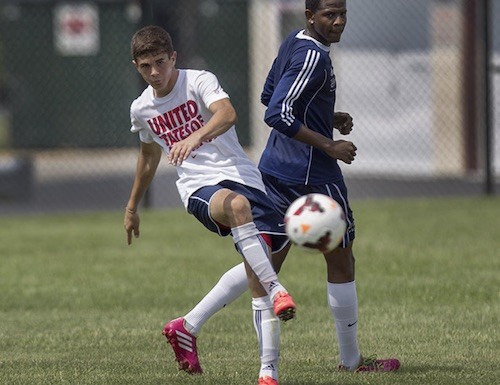
The USMNT’s road to 2030 is already under way, and it starts with youth. Mauricio Pochettino signed a new contract through 2030 in August, and his first squad of the new cycle included three teenagers who all made an immediate impact. For American families and youth coaches, the bigger story is how those players were built, and what that means for the next wave coming through local clubs right now.
Where the 2026 World Cup Left the USMNT
The home World Cup brought real progress and a painful finish. According to U.S. Soccer, the team won its group outright for only the third time, scored in all five of its matches and beat Bosnia and Herzegovina 2-0 in the Round of 32 for its first knockout-round win since 2002. The run ended in Seattle on July 7, when Belgium won 4-1 in the Round of 16. Malik Tillman scored the U.S. goal.
The lesson most observers took from the Belgium game was about speed of thought and execution at the very top level. Belgium scored 61 seconds after the U.S. equalized. Matches at that level are decided in small moments: a slow first touch, a missed scan, a lost 1v1.
Pochettino’s Contract and Expanded Role
On August 3, 2026, U.S. Soccer announced that Pochettino had agreed to a new contract through 2030. The federation said his role now goes beyond the senior team to include youth development, coaching education and technical guidance across U.S. Soccer. CEO JT Batson said the new project “allows us to build on progress,” and Pochettino said he was excited to bring his staff’s experience “to even more areas of U.S. Soccer.”
That matters for youth soccer: a national team coach with a voice in coaching education can influence how players are developed long before a senior call-up.
Key milestones on the road to 2030
- 2027 Concacaf Nations League and Gold Cup
- FIFA U-17 and U-20 World Cups during the cycle
- The 2028 Olympic Games, hosted in the United States
- 2029 Concacaf Nations League and Gold Cup
- The 2030 FIFA World Cup, hosted mainly by Spain, Portugal and Morocco
The New Faces: A Very Young Player Pool
Pochettino’s first roster of the cycle, 28 players for friendlies against Peru, Chile, Mexico and Canada, signaled a clear shift. Christian Pulisic, Weston McKennie, Tim Weah and Tim Ream were among the established players not called up. In their place came a group of teenagers and first-time call-ups. Eleven players earned their first cap in the 4-1 win over Peru alone.
Cavan Sullivan
The Philadelphia Union attacker, who turned 17 on September 28, debuted against Peru as a 16-year-old and played 62 minutes on the right wing. He is contracted to join Manchester City after he turns 18. He is a left-footed creator who likes to take players on.
Julian Hall
The 18-year-old Red Bull New York forward scored in each of his first two caps, against Peru and Chile, the youngest player in program history to do so. A product of the Red Bulls academy and MLS NEXT Pro, he was a 2026 MLS All-Star and became the youngest player to score an MLS hat trick.
Mathis Albert
The 17-year-old Borussia Dortmund winger from Greenville, South Carolina, drew a penalty on his debut against Peru, then scored in stoppage time against Chile to become the youngest goalscorer in USMNT history. In May 2026 he became the youngest American to play in the Bundesliga.
The supporting cast
Sebastian Berhalter of Middlesbrough had a goal and an assist in each of the first two games. Justin Ellis (Orlando City) headed in the opener against Peru. Philadelphia Union defenders Neil Pierre and Frankie Westfield, New England’s Peyton Miller and Brooklyn Raines, and 17-year-old Red Bull New York midfielder Adri Mehmeti were also named. Not all of them will make the 2030 squad; player pools change over four years.
What These Players Have in Common
Look past the records and a pattern appears. Sullivan, Hall and Albert all reached professional training environments early, and all three are known for technical confidence on the ball rather than size or speed alone.
- Comfort in tight spaces. Each can receive under pressure and keep the ball.
- Willingness to go 1v1. Sullivan in particular is described as fearless when running at defenders.
- Early exposure to quality. Hall came through a club academy and its MLS NEXT Pro team; Albert moved from the LA Galaxy system to Dortmund’s academy.
Most young players will never follow that exact route, and they do not need to. The technical habits behind it, however, can be built anywhere, by any well-prepared coach.
Building the Foundations at Youth Level
The players who will represent the U.S. in 2030 and 2034 are in local clubs today. What happens at U8 to U14 decides how much technical quality they bring to the next stage. Here is a framework coaches can use.
1. Ball mastery every session
Ten to fifteen minutes of individual ball work at the start of practice adds up to dozens of hours a season. Use all surfaces of both feet and keep it game-related: changes of direction, turns and moves to beat an opponent.
2. 1v1 confidence
Create small games where attackers are rewarded for beating a defender. Players who are punished for losing the ball stop trying. Players who are encouraged keep developing.
3. Small-sided games
3v3 and 4v4 games give each player far more touches and decisions than 11v11. They also force constant scanning, which is exactly what separates players at the top level.
4. Let players solve problems
Resist coaching every touch from the sideline. Our article on why you should not be a ‘joystick’ soccer coach explains why decision-making grows when players are allowed to make mistakes.
This order (ball mastery, then 1v1 skill, then small-group play) is the core of the Coerver Coaching pyramid of player development, and it lines up closely with the qualities the new U.S. teenagers are showing.
Session idea: Scan, Receive, Go (20 minutes)
- Mark a 20 x 20-yard square with a small gate on each side. Four servers stand outside, one per side.
- One player works in the middle. A server passes in; the coach holds up a colored cone just before the pass, and the player must check over his or her shoulder, read the color and dribble out through the matching gate.
- Progress by adding a passive defender, then a live defender.
- Rotate every 45 seconds. Coaching points: scan before the ball arrives, open the body, first touch away from pressure.
The Role of Coach Education
U.S. Soccer’s decision to give its senior coach a formal role in coaching education points to a simple truth: national teams are only as good as the youth coaching underneath them. Volunteer and club coaches are where the 2030 and 2034 player pools are being shaped today. If you coach young players and want a structured way to teach these foundations, our review of the Coerver Coaching Youth Diploma 1 explains what the course covers.
Frequently Asked Questions
Who is the USMNT coach for the 2030 World Cup cycle?
Mauricio Pochettino. U.S. Soccer announced on August 3, 2026, that he signed a new contract through 2030 with an expanded role that includes youth development and coaching education.
Who are the young players to watch for the USMNT?
Cavan Sullivan (Philadelphia Union), Julian Hall (Red Bull New York) and Mathis Albert (Borussia Dortmund) all made their debuts in September 2026, with Hall and Albert scoring record-setting goals.
Where is the 2030 World Cup?
The 2030 World Cup will be hosted mainly by Spain, Portugal and Morocco, with three opening matches in Uruguay, Argentina and Paraguay to mark the tournament’s centenary.
Become a Coerver-trained coach.
Coerver Coaching’s online Youth Diploma courses give you a proven method for teaching skills. Youth Diploma 1 covers session planning for players aged 8 to 16. Youth Diploma 2 covers team play.