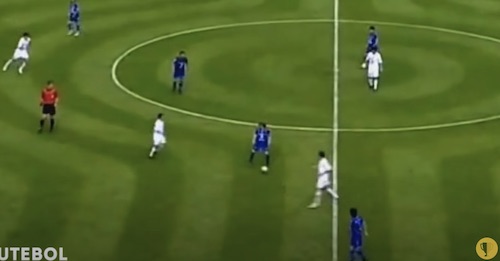









The Cruyff penalty is one of the most famous trick plays in soccer history. Instead of shooting at goal, Johan Cruyff stepped up for Ajax, gently passed the ball sideways to teammate Jesper Olsen, ran forward to take the return pass, and rolled it into an empty net while the goalkeeper was left stranded. It was a give-and-go from the penalty spot.
Is the Cruyff penalty pass legal? Yes. The Laws of the Game only require that the ball is kicked forward from the penalty mark and that the kicker does not touch it again until another player has. Cruyff’s tap went forward, Olsen touched it next, and the goal stood.
The Story Behind the Johan Cruyff Penalty Pass
The famous moment came in December 1982, in an Eredivisie match between Ajax and Helmond Sport. Ajax won the game comfortably, and Cruyff, then in the later years of his playing career and back at the club where he became a star, chose to take his penalty in the most audacious way imaginable.
Cruyff and Olsen, a Danish winger, had rehearsed the idea. Cruyff played the ball a short distance to his left, Olsen ran onto it and returned it, and Cruyff finished into the open goal. The Helmond goalkeeper, who had prepared for a shot, was left with no chance.
Some fans saw it as showing up the opponent. Others saw it as pure Cruyff: a player and thinker who always looked for a smarter way to solve a problem. Cruyff is reported not to have invented the idea himself, as a similar penalty is said to have been taken in the 1950s by Belgian players, but his version is the one the world remembers. Cruyff, a legend for Ajax, Barcelona, and the Netherlands, died in 2016, and this penalty remains one of the clips most tied to his name.
Why it worked
Goalkeepers prepare for a penalty by reading the kicker. Once the ball moves sideways, the goalkeeper has to decide in a split second whether to stay or come out. Whatever choice they make, the attacker with the ball can usually pick the other option. It is a 2v1 against the goalkeeper with the defenders still outside the box.
How to Do the Cruyff Penalty Pass: Step by Step
- Plan it with a teammate. This only works if both players know exactly what is happening. Agree on the signal, the side, and the timing in training.
- Line up legally. Your teammate must start outside the penalty area and the penalty arc, and behind the penalty mark, just like every other player except the kicker and goalkeeper.
- Approach like a normal penalty. Do not give the plan away. Run up at a normal pace and look at the goal.
- Pass the ball forward. The ball must go forward, even if only slightly. A soft side-foot pass at a forward angle toward your teammate’s run is ideal.
- Your teammate times the run. They may enter the box only once the ball is kicked. They arrive as the ball does.
- Return pass and finish. Your teammate either returns it to you or shoots, depending on what the goalkeeper does. Finish calmly. The defenders will be sprinting in.
Common Mistakes
- Passing the ball backward or square. If the ball does not go forward, the referee will award the defending team an indirect free kick.
- The teammate entering the box too early. This is encroachment and can cancel the goal.
- Touching the ball twice. If the kicker touches it again before another player, the other team gets an indirect free kick.
- Bad timing. This is exactly what went wrong for Arsenal, as you can see below.
- Trying it without practice. Under pressure, an unrehearsed trick usually fails.
The Pires and Henry Penalty That Went Wrong
Arsenal legends Thierry Henry and Robert Pires tried to recreate the Cruyff penalty against Manchester City in 2005. Pires ran up to pass the ball forward for Henry, but he failed to play it properly. The attempt broke down, no goal was scored, and Manchester City were given a free kick. It takes not only confidence but perfect timing to pull this penalty off.
More than 30 years after Cruyff, Lionel Messi and Luis Suárez pulled it off for Barcelona against Celta Vigo in 2016, with Messi passing and Suárez finishing. Barcelona’s version was widely seen as a tribute to Cruyff, who had shaped so much of the club’s identity.
Practice Session: Trick Penalty Rehearsal
Use this 25-minute block at the end of a finishing session with a goalkeeper.
- Penalty technique (6 minutes). Each player takes 4 normal penalties to warm up their striking technique.
- Walk-through (4 minutes). Pairs walk through the forward pass, the teammate’s run, and the return pass without a goalkeeper.
- Timing reps (7 minutes). At half speed, then full speed, each pair performs 6 Cruyff penalties against the goalkeeper. Focus on the forward pass and the teammate not entering early.
- Live defenders (8 minutes). Add two defenders who start on the edge of the box and can sprint in once the ball is kicked. Each pair gets 4 attempts and must finish before the defenders recover.
The Coerver Angle
Coerver Coaching has long taught that creativity is built on technical confidence. The Cruyff penalty is creative, but it depends on simple skills done perfectly: a weighted pass, a well-timed run, and a composed finish. When players have that level of ball mastery, they can think about clever solutions instead of worrying about the basics. Encourage young players to be inventive in practice, and to understand the rules well enough to use them.
For more penalty ideas, see Lionel Messi’s trick penalty kick, read how the pros shoot PKs, and learn whether the paradinha penalty is legal.
Frequently Asked Questions
Is the Cruyff penalty legal?
Yes. The ball must be kicked forward, the kicker cannot touch it again until another player does, and teammates must stay outside the area until it is kicked. If those conditions are met, the goal counts.
Who did Cruyff pass to on his famous penalty?
He passed to Jesper Olsen, the Danish winger, who returned the ball for Cruyff to score for Ajax against Helmond Sport in 1982.
Who else has scored a Cruyff-style penalty?
The best-known modern example is Lionel Messi passing to Luis Suárez for Barcelona against Celta Vigo in 2016.
Why did the Pires and Henry penalty fail?
Pires did not play the ball properly on his pass, so the move broke down and Manchester City were awarded a free kick. It shows how precise the timing and touch must be.